
By Dr. Asadullah Karimov – Director General for South Africa and Kazakhstan Trading and Cultural Association
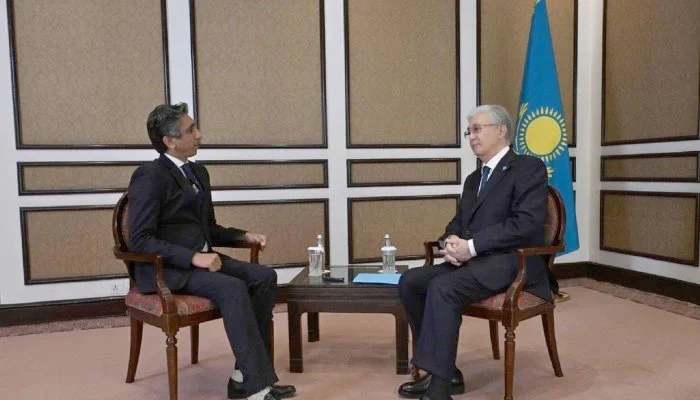
In an exclusive interview during his state visit to Pakistan, the President of Kazakhstan Kassym-Jomart Tokayev outlined the country’s foreign and domestic policy priorities, presenting them through a pragmatic and strategically calibrated lens. His remarks highlight a consistent emphasis on stability, economic development, connectivity, and adherence to international law as guiding principles of state policy.
In regional terms, relations with Pakistan are framed primarily through economic cooperation and transport connectivity. The focus on scaling up trade, expanding joint ventures, and advancing the Kazakhstan–Turkmenistan–Afghanistan–Pakistan corridor reflects a broader strategy of diversifying trade routes and strengthening Kazakhstan’s role as a transit hub between Central and South Asia. Connectivity is treated not as a symbolic objective, but as a concrete instrument for market access and economic resilience.
On global affairs, the president’s comments suggest a realist approach grounded in national interest and institutional pragmatism. His positive assessment of Donald Trump’s policies underscores a shared emphasis on law and order, state capacity, and economic performance. At the same time, Kazakhstan’s foreign policy positioning remains multi-vector: support for the Abraham Accords is presented as a contribution to dialogue and economic opportunity, while continued backing of a two-state solution demonstrates an effort to maintain balanced relations in a sensitive geopolitical environment.
The discussion of the Board of Peace indicates support for flexible diplomatic mechanisms that complement existing multilateral institutions rather than replace them. This aligns with Kazakhstan’s longstanding preference for dialogue platforms and mediation initiatives, while avoiding direct confrontation with established international structures such as the United Nations.
Regarding major geopolitical conflicts, including Ukraine and Gaza, the president reiterates a consistent line: political and diplomatic solutions are the only sustainable path forward. Kazakhstan does not seek a central mediating role but signals readiness to provide neutral ground for negotiations. This position reflects caution, neutrality, and respect for sovereignty, all of which are recurring themes in the country’s external engagement.
The section on constitutional reform reveals the domestic dimension of this broader strategy. The transition away from a super-presidential model toward a system with consolidated checks and balances, the creation of a unicameral parliament, and the introduction of new institutional mechanisms point to a recalibration of governance structures. The emphasis on human rights, unity, and social harmony signals an effort to anchor political transformation in clearly articulated constitutional principles.
Finally, the development trajectory outlined in the interview combines economic diversification, digital transformation, and infrastructure expansion. The focus on artificial intelligence, energy sector modernization, and investment climate stability reflects a long-term strategy aimed at strengthening competitiveness while improving living standards.
Taken together, the interview portrays a leadership approach that prioritizes institutional stability, economic pragmatism, and balanced diplomacy. It positions Kazakhstan as a state seeking to navigate a complex international environment through calculated partnerships, legal frameworks, and gradual internal reform.